Key Takeaways
- Working capital is becoming a strategic source of financial resilience for healthcare organizations.
- Faster, more predictable payments can unlock cash tied up in complex processes and strengthen liquidity.
- More effective working capital management can preserve capacity for innovation, modernization and patient-focused investment.
- Payment modernization and liquidity solutions can help healthcare organizations navigate uncertainty and act with greater flexibility.
Healthcare organizations are being asked to invest through uncertainty, but much of the capital they need may already be trapped in slow, fragmented payment processes.
As reimbursement grows more variable and transactions more complex, the speed and predictability with which money moves increasingly shape access to liquidity. That makes payment efficiency a strategic priority and a critical source of financial resilience.
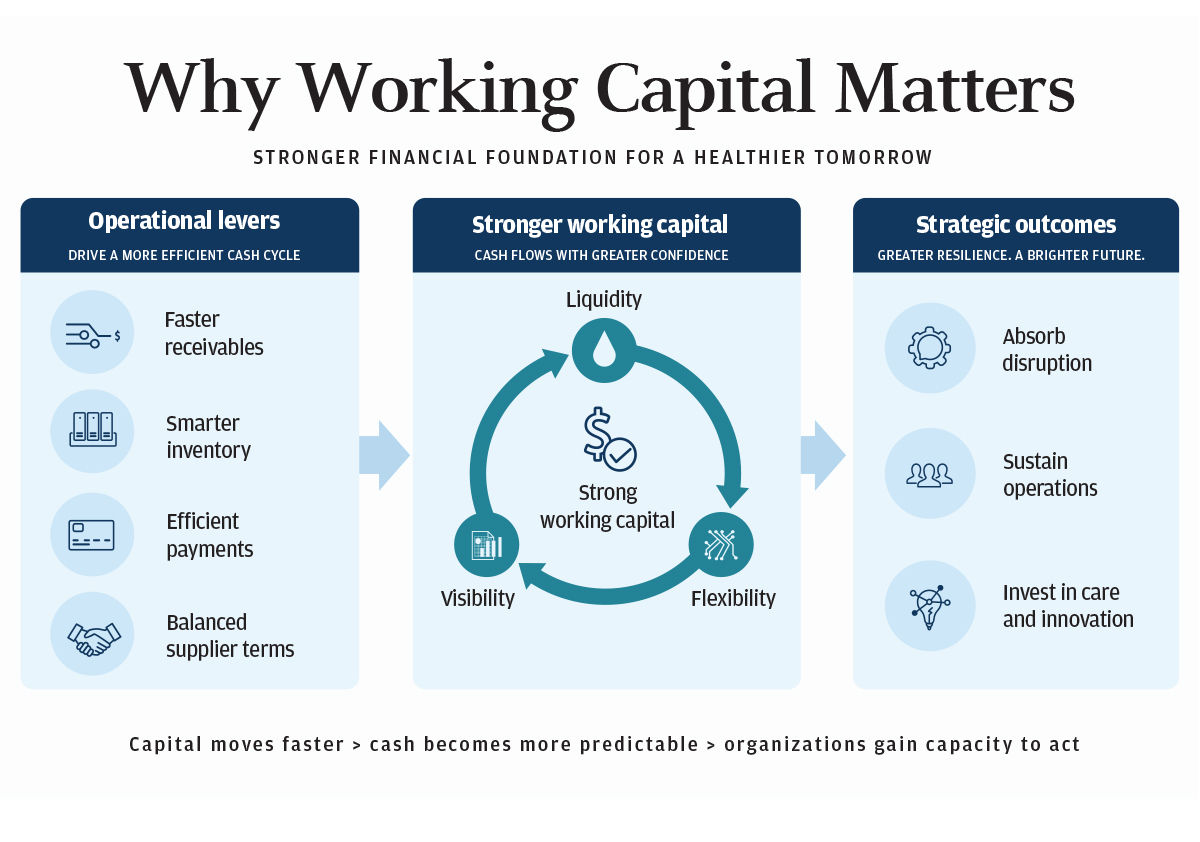
The Healthcare Working Capital Index shows that cash conversion cycles have shifted meaningfully since 2022. Although the pressures differ by subsector, the broader implication is clear: more efficient payments can strengthen working capital, and stronger working capital can help healthcare organizations absorb disruption, sustain operations and continue investing through uncertainty.
Healthcare Complexity Is Putting Pressure on Working Capital
Healthcare organizations cannot eliminate market or regulatory volatility, but they can strengthen their ability to operate through it. Reimbursement variability, payment and settlement complexity, rebate and chargeback structures, inventory requirements and supply chain disruption can all keep cash tied up longer and make liquidity more difficult to predict.
For providers, claim denials, appeals and reimbursement delays can extend the time between delivering care and receiving payment. Improving denial prevention, accelerating appeals and applying automation where appropriate may help shorten that cycle and make cash flows more predictable.
Payers face a different timing challenge. Changes in enrollment, claims volumes and reimbursement requirements can create mismatches between cash inflows and outflows, increasing the importance of liquidity planning and visibility.
Inventory adds another dimension. Recent supply chain disruptions have led some organizations to hold larger reserves of critical medications, devices and other essential products. That added protection can support continuity of care, but it also ties up capital that might otherwise support strategic growth initiatives.
At the same time, healthcare organizations are investing in digital modernization, cybersecurity, automation and emerging technologies to improve efficiency and competitiveness. While these initiatives can create long-term value, they often require significant upfront investment, increasing the importance of maintaining adequate liquidity and working capital flexibility.
The objective is not to choose between operational and financial resilience, but to manage working capital in a way that supports both. Among these pressures, payment friction represents one of the most direct opportunities for healthcare organizations to release capital already moving through the system.
Payment Efficiency Can Strengthen Working Capital
Payment efficiency is one of the most direct working capital levers. Delays, exceptions and manual handoffs across claims, collections, rebate settlements, supplier payments and reconciliation can keep cash tied up and reduce confidence in when it will become available.
Modernizing these processes can accelerate receivables, improve payment and remittance matching, reduce manual reconciliation and strengthen cash visibility. Connecting provider, payer and patient payment information can also make settlement and cash application more efficient across the payment lifecycle.
More efficient movement of money can shorten the time between delivering care, completing a transaction and accessing usable cash. That strengthens working capital, giving healthcare organizations a more dependable financial foundation for managing reimbursement variability and market disruption.
Stronger Working Capital Creates Investment Capacity
When capital remains tied up in receivables, inventory or other operating requirements, it is unavailable for innovation and growth. More effective working capital management can help release capital for strategic priorities.
A stronger working capital position can give organizations more room to navigate reimbursement or settlement delays, meet inventory needs and continue investing through periods of uncertainty. It may also reduce the need to rely on incremental borrowing for routine operating demands.
The goal extends beyond improving days sales outstanding, days inventory outstanding or cash conversion cycle metrics. It is to create the capacity to act when opportunities or challenges emerge.
Liquidity Solutions Can Help Close Timing Gaps
Process improvements cannot eliminate every timing gap. Receivables, payables and liquidity solutions can complement payment modernization by accelerating access to cash, creating payment flexibility without unnecessarily disrupting suppliers and aligning funding with inventory or other operating needs.
These tools do not remove volatility. They help prevent unavoidable timing mismatches from limiting an organization's ability to operate and invest.
Working Capital and Affordability Can Advance the Same Goal
Any discussion of working capital in healthcare should also acknowledge affordability. Improving working capital is not about increasing the cost of care or intensifying patient collection strategies. It is about making better use of resources already moving through the healthcare ecosystem.
Payment delays, reconciliation issues, administrative complexity, settlement timing and excess inventory can all prevent resources from being used effectively. Reducing that friction can improve organizational performance while creating more flexibility to simplify billing, payment and other financial interactions for patients.
Five Ways Organizations Can Unlock Working Capital
While the specific opportunities vary across healthcare subsectors, organizations often strengthen working capital by focusing on payment efficiency, visibility and liquidity management.
Expand payment flexibility
Support timely payments and efficient disbursements through modern payment experiences and digital payment capabilities.
Reduce billing and payment friction
Replace manual and paper-based processes with more efficient, digital workflows.
Increase straight-through processing
Connect payment, revenue cycle and operational systems to reduce manual intervention, exceptions and reconciliation effort.
Evaluate supplier payment strategies
Review payment timing and terms while balancing liquidity goals with supplier relationships and operational continuity.
Assess liquidity solutions selectively
Consider solutions that can accelerate access to cash tied up in receivables, inventory or other operating assets where appropriate.
Working Capital Is a Strategic Healthcare Priority
Healthcare leaders have traditionally viewed working capital primarily as a measure of operational efficiency. Today, it must also be viewed as a strategic resource: a financial buffer against reimbursement variability, payment complexity, inventory demands and market volatility, as well as a source of capacity for innovation, modernization and patient-focused investment.
The organizations best positioned to navigate change may not be those with the largest budgets, but those that make the most effective use of the capital already moving through their businesses.
In an environment defined by uncertainty, working capital is no longer simply a measure of operational efficiency. It is a source of resilience, a driver of strategic flexibility and, increasingly, a competitive advantage for organizations seeking to invest, innovate and grow despite ongoing market disruption.
Read the Healthcare Working Capital Index to learn how working capital performance is evolving across healthcare subsectors and identify opportunities to strengthen financial resilience.
Get InstaMed In Your Inbox!
Join our mailing list to stay up-to-date with the latest industry trends, insights, innovation and technology!